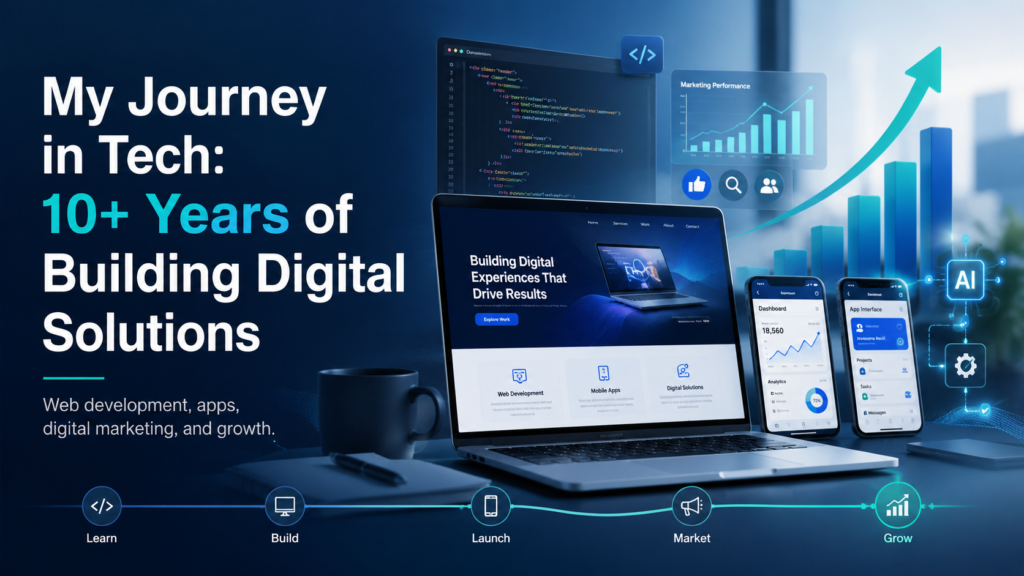
Technology has transformed rapidly over the past decade. Websites have evolved into complete digital platforms, mobile applications have become central to customer engagement, and artificial intelligence is changing how businesses operate.
Throughout these changes, one principle has remained constant for me:
Technology should solve real business problems—not create additional complexity.
My journey in technology began with a curiosity about how websites worked. Over time, that curiosity developed into a career spanning web development, mobile applications, e-commerce, digital marketing, project management, automation, and business growth strategy.
Today, after more than 10 years in the industry and working on over 150 projects, I help businesses use technology, automation, and digital marketing to build better customer experiences and achieve measurable growth.
Where My Technology Journey Began
Like many developers, I started by learning how websites were built.
In the beginning, my focus was primarily technical. I spent time understanding HTML, CSS, JavaScript, PHP, WordPress, databases, hosting environments, and server management.
Every new project introduced a different challenge.
One client needed a professional business website. Another required an e-commerce platform. Some needed faster websites, better search visibility, payment integrations, custom functionality, or improved conversion rates.
These projects taught me something important very early in my career:
A successful website is not simply a collection of pages. It is a business tool.
A website should help a company communicate clearly, generate enquiries, sell products, automate processes, or provide a better experience to customers.
This understanding changed the way I approached development.
Instead of asking only, “How should this feature be built?” I began asking:
- What business problem does this feature solve?
- How will customers use it?
- Can the process be simplified?
- Will it support the company as it grows?
- How will we measure whether it is successful?
That shift from purely technical execution to business-focused problem-solving became the foundation of my career.
Expanding Beyond Website Development
As I worked with more businesses, their requirements became increasingly complex.
A website was often only one part of a larger digital ecosystem. Businesses also needed mobile applications, customer dashboards, e-commerce automation, search engine optimisation, advertising campaigns, analytics, and integrations with third-party platforms.
To deliver better outcomes, I expanded my knowledge across multiple technologies and business areas.
Over the years, I have worked with platforms and technologies such as:
- WordPress and WooCommerce
- Shopify
- React and Next.js
- Laravel and PHP
- Django and Python
- Flutter and mobile application development
- Search engine optimisation
- Google Ads and Meta Ads
- Conversion optimisation
- API integrations and workflow automation
Learning across these areas helped me understand how different parts of a digital business connect.
For example, increasing advertising spend cannot solve a poorly designed landing page. A modern e-commerce website will not deliver strong results without good product positioning. Automation cannot improve a process that has not first been clearly understood.
Successful digital growth requires technology, marketing, data, and business strategy to work together.
From Developer to Technology and Growth Consultant
As my experience increased, my responsibilities expanded beyond writing code.
I began managing teams, communicating directly with clients, planning project roadmaps, reviewing technical architecture, managing budgets, coordinating marketing campaigns, and helping businesses prioritise their digital investments.
This transition helped me see technology from a leadership perspective.
A developer may focus on completing a feature. A business owner, however, needs to understand whether that feature will save time, increase revenue, improve customer satisfaction, or support future growth.
My role gradually evolved into connecting these two perspectives.
Today, I work at the intersection of:
Technology: Building reliable websites, applications, dashboards, e-commerce systems, and integrations.
Automation: Reducing repetitive work and improving operational efficiency through intelligent workflows.
Marketing: Helping businesses attract the right audience through SEO, paid advertising, content, and conversion optimisation.
Strategy: Identifying which digital initiatives should be prioritised based on business goals, resources, and expected impact.
This combined approach allows me to support businesses beyond the launch of a website or application.
Working With Businesses Across Different Markets
One of the most valuable parts of my journey has been the opportunity to work with clients and businesses serving customers in India, Canada, the United States, the United Kingdom, Europe, and the Middle East.
Every market has different customer expectations, purchasing behaviour, competition, and communication styles.
A strategy that performs well in one country may require significant changes before it works in another.
Working across markets has taught me to consider factors such as:
- Local customer behaviour
- Mobile and desktop usage patterns
- Search intent
- Payment preferences
- Website accessibility
- Page speed
- Regional competition
- Customer trust signals
- Language and localisation
- Advertising costs and conversion expectations
These experiences have made me more adaptable and have reinforced the importance of understanding the customer before recommending a technology or marketing solution.
What More Than 150 Projects Have Taught Me
Every project has contributed something valuable to my professional growth.
Some projects involved launching new businesses from the ground up. Others focused on improving existing platforms, migrating websites, automating operations, increasing organic traffic, or improving advertising performance.
Across these projects, several lessons have consistently proven important.
Simplicity Creates Better Experiences
The most complicated solution is rarely the best one.
Customers value websites and applications that are fast, clear, and easy to use. Businesses value systems that their teams can understand and manage.
Good technology should reduce friction.
Business Goals Must Come Before Technology
It is easy to become distracted by the latest platform, framework, or artificial intelligence tool.
However, technology should always be selected according to the problem being solved.
The right question is not, “Which technology is popular?”
The right question is, “Which solution is most appropriate for this business?”
Communication Is as Important as Technical Skill
Many digital projects fail because expectations are unclear, decisions are delayed, or teams do not communicate effectively.
Clear documentation, realistic planning, regular updates, and transparent communication can significantly improve project outcomes.
Launching Is Only the Beginning
A website, application, or marketing campaign should never be treated as a one-time activity.
After launch, businesses need to analyse user behaviour, measure performance, gather feedback, and continue improving.
Digital products grow through continuous optimisation.
Results Matter More Than Features
Clients do not invest in technology simply to receive more features.
They invest because they want more sales, better efficiency, stronger customer relationships, improved visibility, or reduced operational costs.
The success of a project should therefore be measured by outcomes, not only by the number of features delivered.
How Artificial Intelligence Is Changing My Work
Artificial intelligence is creating one of the most significant changes I have seen during my career.
Businesses can now use AI to assist with customer support, content creation, data analysis, lead qualification, internal knowledge management, marketing workflows, and repetitive administrative processes.
However, simply adding an AI tool does not automatically improve a business.
The process must first be understood. The data must be reliable. The right safeguards must be implemented. Most importantly, the automation must produce a meaningful business benefit.
My approach to AI is practical rather than promotional.
I look for opportunities where AI can:
- Reduce repetitive manual work
- Improve response times
- Help teams access information faster
- Support better decision-making
- Personalise customer experiences
- Improve marketing and operational efficiency
The objective is not to replace human judgement. It is to give people better tools and more time to focus on valuable work.
My Approach to Building Digital Solutions
Whether I am working on a website, application, e-commerce platform, marketing campaign, or automation workflow, I follow a business-first process.
Understand
The first step is understanding the business, its customers, current challenges, competition, and objectives.
Plan
The next step is converting those requirements into a realistic roadmap with clear priorities, responsibilities, timelines, and success metrics.
Build
During development, I focus on usability, scalability, performance, maintainability, and alignment with the original business goals.
Launch
Before launch, the solution is tested across devices, browsers, workflows, integrations, and realistic customer scenarios.
Measure
After launch, performance is evaluated using analytics, conversions, customer feedback, and operational data.
Improve
The final stage is continuous improvement. The insights gathered after launch guide future development, optimisation, and growth activities.
This process helps ensure that technology investments are connected to measurable outcomes.
Why I Created AmitBatham.com
I created this website to document my professional journey, share practical knowledge, showcase selected projects, and connect with businesses that need support with technology and digital growth.
Through this blog, I plan to share insights on topics including:
- AI automation for businesses
- Website and application development
- WordPress, WooCommerce, and Shopify
- Search engine optimisation
- Google Ads and Meta Ads
- E-commerce growth
- Digital strategy
- Project management
- Conversion optimisation
- Lessons learned from real-world projects
My goal is to make the content practical, honest, and useful.
Rather than discussing technology only at a theoretical level, I want to explain how it can be applied to solve real business challenges.
Looking Ahead
Technology will continue to change.
The platforms and tools we use today may be replaced, improved, or completely reimagined over the coming years. Artificial intelligence will become more deeply integrated into websites, applications, marketing systems, and everyday business operations.
For professionals working in technology, continuous learning is no longer optional.
My focus for the next phase of my journey is to continue combining technical execution, artificial intelligence, automation, marketing, and business strategy.
I want to help businesses move beyond disconnected digital tools and build systems that work together—systems that save time, improve customer experiences, and support sustainable growth.
More than 10 years into this journey, I remain just as curious about technology as I was when I started.
The difference is that today, I understand that the most valuable technology is not necessarily the most advanced.
It is the technology that solves the right problem.
Let’s Build Something Valuable
Are you planning a new website, e-commerce platform, mobile application, automation workflow, or digital growth initiative?
I help businesses turn ideas and operational challenges into practical digital solutions.
Explore my services and selected projects, or schedule a consultation to discuss how technology, automation, and digital marketing can support your business.